


 Cart
Cart
 sales@molnova.com



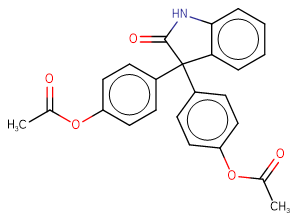
Oxyphenisatin acetate
CAS No. 115-33-3
Oxyphenisatin acetate( —— )
Catalog No. M20707 CAS No. 115-33-3
Oxyphenisatin acetate inhibits the growth of the breast cancer cell lines MCF7 T47D HS578T and MDA-MB-468.
Purity : >98% (HPLC)
 COA
Datasheet
HNMR
HPLC
MSDS
Handing Instructions
COA
Datasheet
HNMR
HPLC
MSDS
Handing Instructions
| Size | Price / USD | Stock | Quantity |
| 10MG | 42 | In Stock |


|
| 25MG | 58 | In Stock |
|
| 50MG | 69 | In Stock |
|
| 100MG | 96 | In Stock |
|
| 200MG | Get Quote | In Stock |
|
| 500MG | Get Quote | In Stock |
|
| 1G | Get Quote | In Stock |
|
Biological Information
-
Product NameOxyphenisatin acetate
-
NoteResearch use only, not for human use.
-
Brief DescriptionOxyphenisatin acetate inhibits the growth of the breast cancer cell lines MCF7 T47D HS578T and MDA-MB-468.
-
DescriptionOxyphenisatin acetate inhibits the growth of the breast cancer cell lines MCF7 T47D HS578T and MDA-MB-468.
-
In VitroOxyphenisatin acetate inhibits the growth of the breast cancer cell lines MCF7, T47D, HS578T, and MDA-MB-468. In the estrogen receptor (ER) positive MCF7 and T47D cells, oxyphenisatin acetate induces TNFα expression and TNFR1 degradation, indicating autocrine receptor-mediated apoptosis in these lines. Ten micromoles per liter Oxyphenisatin acetate treatment results in autophagy and mitochondrial dysfunction.
-
In VivoOxyphenisatin acetate (300 mg/kg, i.p.) delivers intraperitoneally inhibited tumor growth, accompanied by phosphorylation of eIF2α and degradation of TNFR1 in an MCF7 xenograft model.
-
Synonyms——
-
PathwayAutophagy
-
TargetAutophagy
-
RecptorAutophagy
-
Research Area——
-
Indication——
Chemical Information
-
CAS Number115-33-3
-
Formula Weight401.41
-
Molecular FormulaC24H19NO5
-
Purity>98% (HPLC)
-
SolubilityDMSO:150 mg/mL (373.68 mM)
-
SMILESCC(=O)Oc1ccc(cc1)C1(C(=O)Nc2ccccc12)c1ccc(OC(C)=O)cc1
-
Chemical Name2-Indolinone 33-bis(p-hydroxyphenyl)- diacetate
Shipping & Storage Information
-
Storage(-20℃)
-
ShippingWith Ice Pack
-
Stability≥ 2 years
Reference
1.Morrison B L Mullendore M E Stockwin L H et al. Oxyphenisatin acetate (NSC 59687) triggers a cell starvation response leading to autophagy mitochondrial dysfunction and autocrine TNFα-mediated apoptosis[J]. Cancer Medicine 2013:n/a-n/a.
molnova catalog



related products
-
SP-8356
SP-8356 is a potent, orally active inhibitor of cluster of differentiation 147 (CD147) with anti-atherosclerotic effects.
-
CP-312
CP-312 (Cardioprotectant 312) is an antioxidant defense response activator that protects hiPSC-CM viability by acting through induction of heme oxygenase-1 and targeting the antioxidant response network by inducing HMOX1 expression.
-
GC7 Sulfate
GC7 Sulfate is a potent inhibitor of deoxyhypusine synthase (DHS). Eukaryotic translation initiation factor 5A2 (eIF5A2) is the only known substrate for DHS, so GC7 inhibits the activation of eIF5A2 by inhibiting DHS activity.
